When a London-based SaaS company scaled from £5M to £25M ARR in eighteen months, its founding team faced a problem they hadn't budgeted for: they needed to hire twelve go-to-market roles across marketing, sales, and revenue operations—fast—without destroying quality or culture. Traditional generalist agencies sent hundreds of CVs. None understood the nuance between a demand-gen manager and a lifecycle marketer. None grasped why a RevOps hire needed both Salesforce architecture skills and commercial acumen. The founders spent six weeks interviewing the wrong candidates before switching to 3searchgroup, a specialist commercial recruitment agency that delivered three shortlists in nine days and closed all twelve hires within eight weeks. That shift—from volume to precision—illustrates why expertise, process, and network depth matter when building revenue engine teams.
This guide explains how specialist commercial recruitment works, why a matrix structure by skillset and geography accelerates hiring, and what hiring managers should expect from permanent, interim, and executive search services tailored to go-to-market functions.
Why Specialist Commercial Recruitment Agencies Outperform Generalists
Generalist recruiters treat marketing, sales, product, digital, and revenue operations as interchangeable boxes on an org chart. Specialists recognize that a growth marketer, a field sales director, a product manager, and a RevOps analyst require entirely different competency frameworks, salary bands, interview processes, and candidate networks.
A commercial recruitment agency focused on revenue engine teams operates with recruiters who immerse themselves in one function, one industry vertical, or one geography. That immersion builds three advantages. First, recruiters know the talent before the job opens—they attend the same events, read the same Slack channels, and track career moves in real time. Second, they speak the language—understanding that "pipeline velocity" means something different to a sales ops leader than to a paid-media manager. Third, they map the market—knowing which competitors pay above benchmark, which startups are cutting headcount, and which geographies have undersupplied talent pools.
For hiring managers, this expertise translates into shorter time-to-shortlist, higher offer-acceptance rates, and better long-term retention. Instead of reviewing fifty mediocre CVs, you interview six candidates who match competency, culture, and career trajectory. Instead of negotiating blind, you receive salary benchmarking data and counteroffer intelligence. Instead of onboarding in isolation, you access post-hire coaching and peer networks that accelerate ramp time.
Services Portfolio: Permanent, Interim, Executive, and Team Build Recruitment
Revenue engine hiring spans multiple service models. Understanding which to deploy—and when—determines speed, cost, and quality of outcome.
Permanent Recruitment for Go-To-Market Functions
Permanent recruitment remains the foundation of team building. Whether you need a single critical hire or a coordinated multi-role build, specialist agencies structure the process to reduce hiring manager burden and improve candidate experience.
Marketing recruitment covers brand, growth, lifecycle and CRM, performance, content, product marketing, and demand generation. Sales recruiters place SDRs, BDRs, account executives, account managers, sales operations, enablement, and inside and field sales leadership. Product management recruitment spans product managers, product owners, heads of product, and product leadership. Digital recruitment agency services include eCommerce, acquisition, analytics, UX and CX, conversion rate optimization, SEO, SEM, and paid media. Revenue operations recruiters source RevOps strategists, systems administrators, GTM analysts, sales ops, and marketing ops professionals.
Permanent hires typically follow a four-phase process: discovery and scoping to define role clarity, competencies, and salary bands; market mapping and targeted outreach to passive candidates; screening, shortlisting, and interview coordination; and offer management plus onboarding support. Service-level agreements specify update frequency, time-to-shortlist targets, and feedback loops. For mid-level roles, agencies often work on contingency—fee on placement. For leadership or multi-hire builds, clients may prefer a retained model with staged payments to secure dedicated capacity.
Interim Recruitment and Contract Talent for Urgent Gaps
Interim recruitment solves the problem of needing expertise now—to stabilize pipeline during a leadership transition, cover maternity or paternity leave, execute a product launch, or lead a transformation program.
Specialist agencies maintain vetted interim benches across marketing, sales, product, digital, and revenue operations. These professionals operate on day rates or fixed-term contracts, with notice periods measured in weeks rather than months. Shortlists arrive in days. Candidates start within a fortnight. Quality remains high because interim specialists build their careers on rapid impact and referenceability.
Typical use cases include interim heads of revenue operations to design and implement new GTM systems, fractional CMOs to shape strategy before a permanent hire, contract performance marketers to scale paid acquisition during peak season, and project-based product managers to ship a defined feature set.
Executive Search for Commercial Leaders
Executive search operates differently. Retained fees, longer timelines, deeper assessment, and white-glove process reflect the stakes of hiring a VP or C-suite leader who will shape strategy, culture, and investor confidence.
Specialist executive search for commercial roles—Chief Revenue Officer, Chief Marketing Officer, Chief Product Officer, Chief Growth Officer, VP Sales, VP Marketing, VP Product—requires market mapping, confidential outreach, rigorous competency and culture assessment, stakeholder alignment across board and executive team, and employer brand storytelling to land scarce leadership talent.
Timelines stretch from eight to sixteen weeks. Fees are staged: retainer on engagement, milestone payment at shortlist, and balance on placement. Replacement guarantees extend to twelve months, reflecting the investment and risk.
First-Hire Support and Team Build Recruitment
First hires carry outsize importance. Your first marketer defines brand voice. Your first RevOps hire determines system architecture. Your first salesperson sets the tone for customer relationships. Mistakes here compound.
Specialist agencies offer advisory-led recruitment for these foundational roles—clarifying scope, setting realistic salary expectations, designing interview frameworks, and sourcing candidates who thrive in ambiguity and can build from scratch. The same consultative approach scales to team build recruitment, where you need to hire multiple roles in parallel—coordinating job design, sequencing hires to avoid bottlenecks, and maintaining candidate experience across a high-volume pipeline.
The Advise–Attract–Develop Approach: Strategy, Sourcing, and Post-Hire Performance
The best recruitment partnerships extend beyond transactional placement. A consultative model improves hiring outcomes and long-term team performance.
Advise: Strategy Before Search
Before posting a job, specialist recruiters run discovery workshops to clarify goals, headcount plans, org design, role scopes, and success metrics. They deliver market intelligence—salary benchmarking, competency frameworks, competitor hiring activity, talent supply and demand by geography—and help design interview processes that reduce bias, improve predictive validity, and accelerate decision-making. This advisory phase aligns stakeholders, reduces time-to-hire, and produces evidence-based hiring plans tailored to each function.
Attract: Source Niche, High-Caliber Candidates
Attraction combines multiple channels. Niche communities, industry events, content marketing, referrals, and targeted outreach to passive talent create a pipeline broader than job boards. Specialist recruiters elevate employer brand through storytelling that resonates with the target persona, craft inclusive job descriptions that reduce demographic bias, and apply structured, competency-based screening to improve quality-of-hire while supporting diversity, equity, and inclusion goals.
For functions like revenue operations, where talent is undersupplied and poorly understood, specialist networks become decisive. RevOps professionals rarely search job boards. They move through referrals, Slack groups, and direct headhunting. Access to these hidden networks distinguishes specialist agencies from generalists.
Develop: Post-Hire Performance and Retention
Placement is not the finish line. Specialist agencies offer onboarding guidance, leadership coaching access, and enablement toolkits to accelerate ramp time. They host events—roundtables, webinars, award series, and networking dinners—that connect leaders across marketing, sales, product, digital, and RevOps, building peer support and shared learning. These touchpoints improve retention, performance, and referenceability, creating a virtuous cycle that benefits both client and candidate.
Specializations and Matrix Structure: Coordinator to C-Suite Across Revenue Engine Teams
Revenue engine teams span multiple functions and seniority levels. A matrix structure—where recruiters specialize by skillset, industry vertical, and geography—delivers better shortlists faster.
Marketing recruitment includes roles from marketing coordinator and marketing executive through to CMO and VP Marketing, covering brand, growth, lifecycle, performance, content, product marketing, and demand generation. Sales recruiters place SDR, BDR, AE, AM, sales operations, enablement, sales leadership, and CRO roles. Product management recruitment spans product manager, product owner, head of product, VP Product, and CPO. Digital recruitment covers eCommerce manager, acquisition manager, analytics lead, UX and CX director, CRO specialist, SEO and SEM manager, and paid media lead. Revenue operations recruiters source RevOps analysts, RevOps managers, heads of RevOps, and VP RevOps.
This matrix structure means a client hiring a lifecycle marketing manager in London speaks to a recruiter who lives in lifecycle communities, tracks European lifecycle talent moves, and understands the difference between Braze, Iterable, and Klaviyo expertise. A client hiring a VP Sales in New York speaks to a recruiter who maps the US SaaS sales leadership market, knows which leaders are raising their hand, and benchmarks compensation at series B versus series D.
The outcome: faster shortlists, better candidate fit, higher offer acceptance, and lower regrettable attrition.
UK, US, and Europe Delivery—Plus New Market Expansion
Revenue engine hiring increasingly crosses borders. A London HQ expands to New York. A Berlin startup opens an office in Austin. A Paris scale-up hires remote talent across five countries. Specialist commercial recruitment agencies with UK, US, and Europe delivery combine regional recruiter expertise with global best practices.
Local networks matter. Salary norms, employment law, visa pathways, cultural expectations around remote work, and candidate density vary sharply between Manchester and San Francisco, between Amsterdam and Austin. Recruiters with on-the-ground presence navigate these nuances, improving acceptance rates and reducing post-hire friction.
For companies expanding into new territories, specialist agencies provide market-entry hiring plans, interview process localization, salary benchmarking, and shortlists tailored to your ideal candidate profile. This support accelerates launch timelines without sacrificing quality. When a UK fintech opened a New York office, its recruiter delivered a shortlist of three US-based sales directors within ten days, each with enterprise SaaS experience, regulatory knowledge, and East Coast networks. All three candidates accepted interviews. The hire started six weeks after the search launched.
Proof of Impact: Case Snapshots, Metrics, and Community Engagement
Evidence of performance separates credible agencies from marketing noise. Look for case snapshots with measurable outcomes, transparency on key metrics, and investment in community.
Illustrative examples include a first go-to-market team build for a scaling SaaS firm—twelve hires across marketing, sales, and RevOps in eight weeks, with all hires passing probation and 100% retention at twelve months. An interim RevOps leader deployed within three days to stabilize pipeline reporting during a CRM migration, delivered new dashboards in two weeks, and transitioned to advisory after eight weeks. A retained CMO search for a European expansion—market mapping across UK, Germany, and France, six candidates interviewed, offer accepted within twelve weeks, executive onboarded with peer mentoring and board integration support.
Key metrics to ask agencies include time-to-shortlist (days from brief to first candidate presentation), time-to-offer (weeks from engagement to offer acceptance), fill rate (percentage of searches successfully closed), offer-acceptance rate (percentage of offers accepted versus rejected or countered), and retention at six and twelve months.
Community engagement signals long-term commitment. Agencies that host events, publish research, run award series, and maintain active candidate communities demonstrate investment beyond transactional placement. These activities build talent pipelines, elevate industry knowledge, and create environments where hiring managers and candidates meet before a search opens.
How to Engage: Process, Timeline, Pricing Models, and FAQs
Understanding engagement mechanics removes friction and sets realistic expectations.
Process and Timeline from Brief to Hire
A typical permanent search follows six steps. Discovery and scoping—clarify role requirements, competencies, salary bands, stakeholder alignment—takes one to two days. Market mapping and targeted outreach—identify target companies, build candidate lists, initiate confidential conversations—takes one to two weeks. Screening and shortlist—structured interviews, competency assessment, reference checks—takes one week. Client interviews and feedback loops—coordinate schedules, gather feedback, iterate if needed—takes two to four weeks. Offer management—negotiate terms, handle counteroffers, align start dates—takes one to two weeks. Onboarding support—share onboarding best practices, check in at thirty and ninety days—is ongoing.
Service-level agreements specify update frequency (weekly or bi-weekly), typical time-to-shortlist by role level (mid-level: one to two weeks; senior: two to three weeks; executive: four to six weeks), and collaborative tooling for visibility (shared candidate trackers, interview scorecards, feedback forms).
Pricing Models and Guarantees
Pricing varies by service type and role level. Contingent fees—percentage of first-year salary, paid on placement—suit mid-level permanent roles where multiple agencies may compete. Typical contingent fees range from fifteen to twenty-five percent. Retained fees—staged payments with exclusive engagement—suit leadership hires and team builds where dedicated capacity and white-glove process justify upfront investment. Retained fees split into thirds: engagement, shortlist, and placement. Interim and contract talent operate on day rates (for contractors) or fixed-term contracts (for interims), with agency margin transparent or embedded.
Replacement guarantees align risk. For mid-level permanent roles, agencies typically offer three to six months: if the hire leaves or is terminated within that window, the agency re-runs the search at no additional fee. For senior and executive roles, guarantees extend to twelve months, reflecting higher stakes and longer ramp times.
Frequently Asked Questions for Hiring Managers
Which functions and seniorities do you cover? Specialist commercial recruitment agencies cover marketing, sales, product, digital, and revenue operations from coordinator to C-suite, including interim specialists and executive search for VP and CRO, CMO, CPO, and CGO roles.
How fast can you deliver an interim shortlist? Vetted interim shortlists typically arrive within three to seven days, with candidates available to start within two weeks.
What are your fees and guarantees by service type? Contingent permanent: fifteen to twenty-five percent of first-year salary, three to six month guarantee. Retained executive: staged fees totaling twenty-five to thirty-five percent, twelve-month guarantee. Interim: day rate or fixed-term contract with transparent margin.
Do you support first hires and multi-hire team builds? Yes. Advisory-led recruitment for first hires includes scope definition, salary benchmarking, and interview design. Team build recruitment coordinates parallel searches, sequences hires to avoid bottlenecks, and maintains candidate experience across high-volume pipelines.
Related Categories
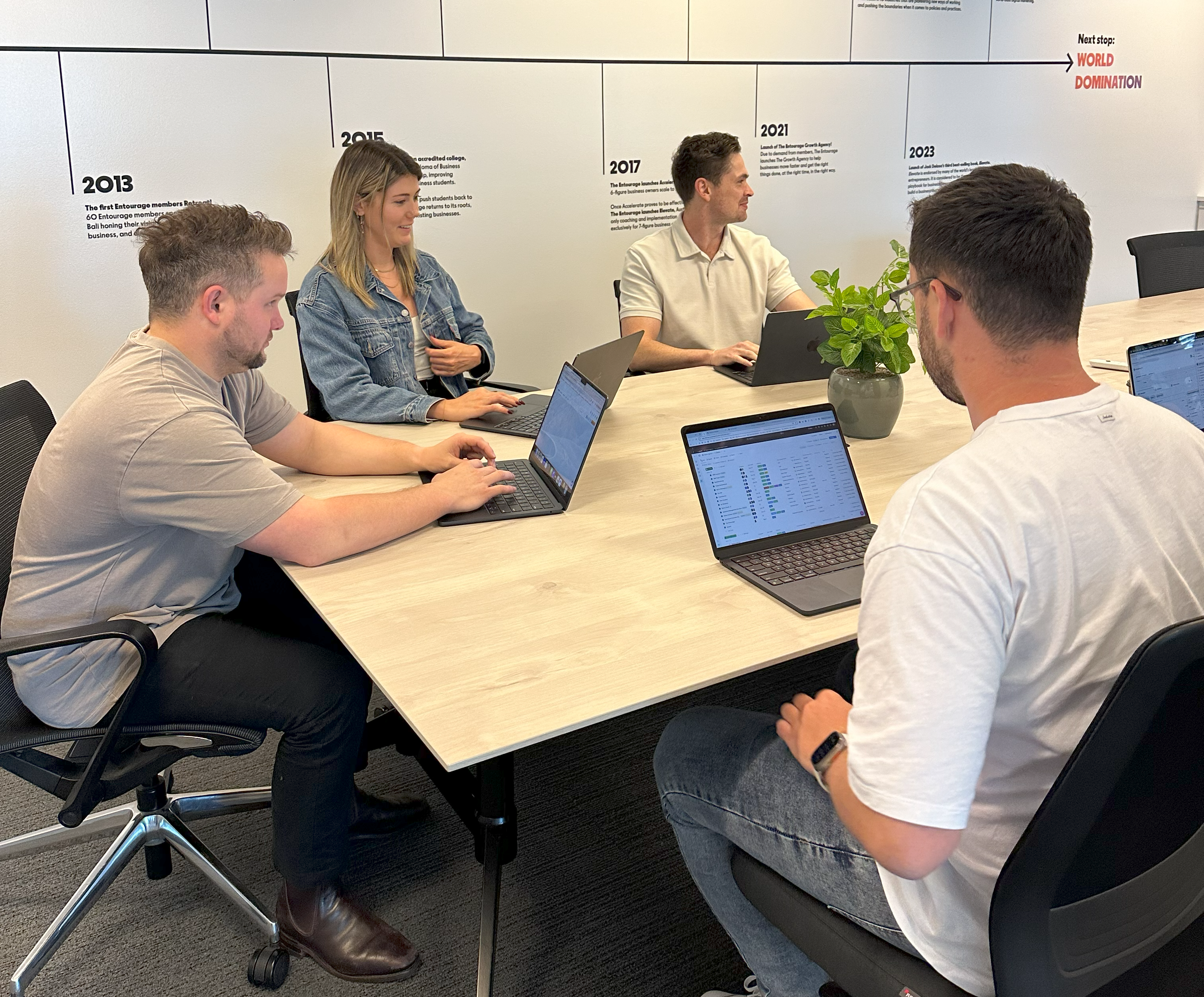




Ryan Terrey
As Director of Marketing at The Entourage, Ryan Terrey is primarily focused on driving growth for companies through lead generation strategies. With a strong background in SEO/SEM, PPC and CRO from working in Sympli and InfoTrack, Ryan not only helps The Entourage brand grow and reach our target audience through campaigns that are creative, insightful and analytically driven, but also that of our 6, 7 and 8 figure members' audiences too.